UBS in a report said it remains “bullish” on the running footwear category despite investor concerns over a pullback in athletic footwear largely traced to weakness at Nike. Analyst Jay Sole believes Nike’s problems are “company-specific” and not a reflection of broader industry weakness.
“We believe the performance athletic footwear industry will continue to deliver very strong growth, underpinned by the global health and wellness trend,” wrote Sole in the note. “Our view is this trend is driving increased participation in sports like running and will be a long-lasting phenomenon.”
Among the signs that of continued healthy demand for performance footwear cited in the note were Circana’s report that running footwear sales grew 13 percent in the U.S. in the first half of 2026, far outpacing the overall U.S. footwear gain in the period of 1 percent.
Sole also cited positive recent second-quarter reports from several major footwear brands. This included a 35 percent constant-currency (cc) quarterly gain by Amer Sports’ Outdoor Performance segment, which is primarily Salomon; a 22.9 percent cc gain at Asics; a 21.6 percent cc increase at On, a 10.3 percent cc gain at Merrell; 9.0 percent cc gain at Saucony, and 7.7 percent cc gain at Hoka. He also noted that Brooks reported a 14 percent gain in the half. The analyst wrote, “Most of these brands also delivered strong North America growth with expanding EBIT margins.”
Finally, Sole noted that running footwear is “still growing” in the double-digit range in Europe through August and cited comments by Urban Outfitters’ CEO Dick Hayne on the retailer’s second-quarter analyst call that all three of the company’s banners – Anthropologie, Urban Outfitters and Free People – “are seeing very strong increases in athletic shoe sales.”
Sole further cited continued healthy underlying trends toward health & wellness, with the pandemic causing global consumers to “take a more proactive approach to managing their health.” An August survey of U.S. consumers from UBS showed 40.7 percent of high-income consumers now exercise at least three times per week, a 60-basis point (bps) increase year-over-year (y/y), a 100-bps increase vs. 2024, and a 350-bps increase vs. 2023
Sole wrote, “Thus, if participation is increasing, industry sales will likely grow as well. We believe the trend seen post reopening has room to improve as participation is still not back to the pre-COVID peak.”
At the same time, UBS believes part of the recent weakness in the valuation of many shares in the athletic footwear space is partly because investors are “conflating Nike’s weakness” with broader industry trends.
Sole wrote, “Since Nike has long been considered an industry bellwether, we believe the market is looking at Nike’s results as a proxy for overall industry health.”
The analyst believes Nike’s challenges are “company-specific,” with the brand having overly focusing on lifestyle products in recent years and downplaying performance athletic styles under former CEO John Donahoe. Sole wrote, “Now the brand finds itself poorly positioned to take advantage of the performance running trend while at the same time its non-athletic products aren’t resonating with consumers the way they used to.”
Sole attributes recent reports of lackluster sales of athletic footwear in the marketplace at Foot Locker, owned by Dick’s, and JD Sports, directly to poor sell-throughs of Nike product.
Sole believes Nike’s retail partners ordered “more inventory for 2026 than their sell-out trend at the time justified” as one of Hill’s priorities was repairing relationships with key wholesale accounts. Retailers, according to Sole, were betting that Nike “would be coming out with better products and supporting those products with big marketing dollars.” He further believes few retailers wanted to risk declining Nike’s orders “in case the brand was about to stage a big comeback.”
However, Nike’s products have underperformed so far in 2026, with the brand’s key wholesale partners, including Dick’s Foot Locker business and JD Sports, now left with “too much inventory and heavy discounting.”
Sole noted that athletic retailers offering a broader mix of athletic brands have performed better. Sole said, “This tells us recent earnings results point to Nike Inc. weakness, not necessarily broader industry weakness.”
Looking ahead, Sole expects many of Nike’s competitors will eventually take share from Nike after excess Nike inventory is cleared. In what he described as an “unusual dynamic,” he noted that the discounting on Nike products required to clear elevated inventories is coming as brands such as On, Hoka, and Under Armour are avoiding promotions.
Sole wrote, “In a typical environment, rival brands are afraid to lose market share to Nike and therefore engage in price matching. We believe brands are acting differently today because they suspect retailers won’t give Nike the benefit of the doubt going forward like it did in in 2025 and in the past.”
He also believes retailers will be increasing orders with brands like On and Hoka not only because they’re selling through better but because they receive better margins on orders versus Nike product. Wrote Sole, “Thus once the excess Nike inventory is cleared, we think retailers will migrate their orders to strong brands which have maintained pricing power and momentum with consumers that also offer higher profit margins.”
Sole reiterated his “Buy” ratings on five stocks tied to the running footwear category: On Holding, Hoka-parent Deckers Outdoor, Amer Sports, Saucon-parent Wolverine Worldwide, and Under Armour. Collectively, the group trades at an average price-to-earnings ratio of 0.9x vs. the S&P 500’s 1.6x ratio. Sole said of the five stocks, “We believe the market is underestimating their growth potential.”
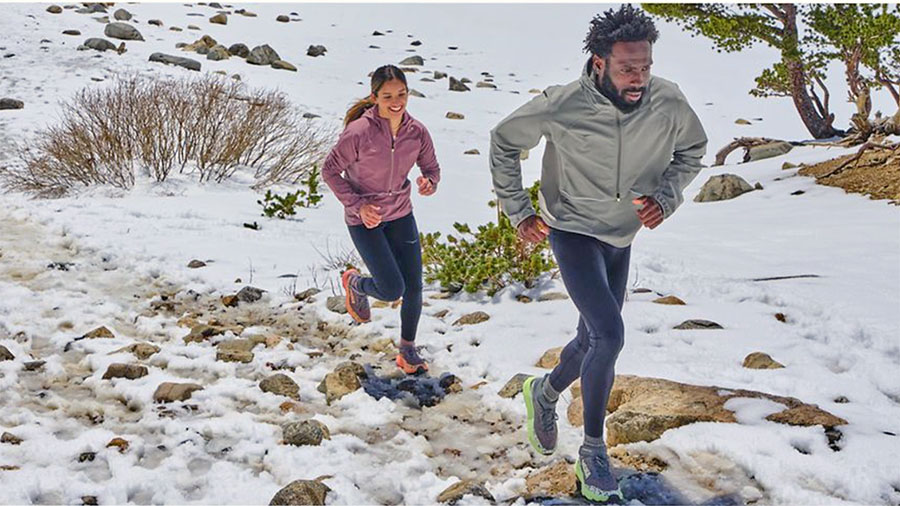
Image courtesy Hoka