
While sharply reducing its guidance for the current year, Nike Inc. on Thursday, October 1 announced yet another multi-year restructuring and operating-model overhaul, called Pace, designed to make the company faster, more locally responsive, and lower costs. Nike didn’t disclose the likely number of affected jobs.
“The future will belong to companies that can move faster, serve athletes and consumers more locally, and invest more aggressively in innovation,” said Elliott Hill, president and CEO, Nike, Inc. in an open letter to Nike employees. “To do that, Nike must make changes to become a more agile, efficient and athlete-focused company.”
He warned of job cuts that won’t be announced until calendar year 2027. Hill said, “This work will result in fewer roles across Nike, and I want to acknowledge that news like this creates uncertainty. I don’t take that lightly. Throughout this process, we will communicate directly, act with transparency and treat people with respect. Decisions about impacted roles related to this work will begin in calendar year 2027 and beyond.”
Building on Nike’s March 2026 cost-realignment plan, the Pace program embraces five key elements:
- Supply-chain modernization: Nike plans to use more technology and a more variable cost structure to make its global supply chain more flexible and responsive to demand.
- Three geographic regions: Nike will reorganize from four regions into Americas, APGC (Asia Pacific & Greater China), and EMEA, shifting more decision-making and resources closer to local markets.
- New India campus: Nike plans to establish a new campus in India to expand enterprise capabilities and access to talent.
- Workforce reductions: The restructuring will eliminate roles as Nike streamlines its organization. The company has not yet specified the number of jobs or locations affected; decisions on impacted roles are expected to begin in 2027.
- Cost savings: Nike expects approximately $2.5 billion in cumulative savings through fiscal 2031, before restructuring costs and future reinvestment. It expects roughly $1 billion of pre-tax charges, primarily employee-related, through FY2031, on top of about $300 million in severance already recognized in FY2026.
Scaling Sport Offense
Rather than a cost-cutting exercise, Nike in its press release described Pace as an “operating model transformation to accelerate and scale the success of the Sport Offense.”
On Nike’s fiscal first quarter analyst call, Elliott Hill, president and CEO, Nike, Inc., said the Sport Offense initiative, which places greater emphasis on sports, product innovation, and athlete/consumer connection, is “driving results,” particularly in Performance categories.
Overall, Nike’s Performance categories grew “another high single digits” in the fiscal first quarter ended August 31, continuing their momentum from recent quarters. Running was up double digits, global football grew “strong” double digits in all four geographies with the benefit of the World Cup, and training grew globally, led by EMEIA. Basketball was up double digits in North America while both tennis and golf grew double digits.
However, Hill noted that the Nike Performance business “is not yet large enough to offset the pressure we’re seeing in Nike Sportswear, Jordan Brand, and Greater China.”
He added, “We’re taking deliberate actions to strengthen those businesses, but realizing the full benefit of those efforts will take time.”
Overall, sales were down 5 percent on a currency-neutral basis. Nike Sportswear sales declined in the low double digits, Jordan Brand fell in the mid-teens, and China’s revenues were down 26 percent. Sportswear represented just under half of Q1 revenue, China made up 10.8 percent of quarterly sales, and Jordan represented 13 percent.
Hill said the Pace program aims to more quickly extend the benefits the Sport Offense initiative across the business.
“When teams get closer to the athlete, the consumer, and the marketplace, they make better decisions,” said Hill. “Over the past year, we have taken steps to make certain that the rest of the company can move at the same speed. That is the thinking behind Pace, a program that brings several operational changes together under one effort.”
He added, “The purpose of Pace is clear. Accelerate the Sport Offense. It will change how and where we work, move decisions and roles closer to the consumer, and build capabilities that will allow us to move faster. The sport offense is proving itself. Pace is how we scale it.”
He said the first element is to evolve the supply chain from a “mostly fixed structure to one that is more flexible, responsive, and cost-effective.” He said those efforts are “already underway.”
Nike is also establishing a new campus in Bengaluru, India to support new operating capabilities across multiple functions. Hill said, “They will work closely with the teams around the world to run the business with greater speed and precision. These full-time Nike teammates will span across a number of functions across the company.”
Also as part of the plan, Nike is reorganizing into three geographies: Americas (North America and Latin America), APGC (Asia Pacific and Greater China), and EMEIA (Europe, Middle East, and Africa). Currently, Nike has four geographies: North America, EMEIA, Greater Chain and Asia Pacific & Latin America. Hill said of the reorg move, “We will reduce layers and move more resources to the countries, territories, and cities, and give our local teams more ownership of winning in their markets. We expect teams to move into this new formation in fiscal year 28.”
Finally, the plan calls for workforce changes. Hill said, “In some areas, we will add capabilities to increase speed and scale, and others will eliminate duplication. Over time, those changes will reduce the overall number of roles across Nike, Inc.”
Dave Denton, Nike’s new CFO, on the call said the cost to implement Pace will be approximately $1 billion over the program’s life, which is in addition to approximately $300 million of severance-related costs in fiscal 2026. Denton said, “We have begun taking actions and expect the majority of the program savings to be realized in fiscal years 2029 and 2030, with the full realization of the program to continue into fiscal year 2031.”
He further said Nike plans to reinvest a portion of the approximately $2.5 billion in savings from the program “back into the business with discipline, prioritizing the opportunities with a clearer strategic impact and the strongest return.”
Nike officials promised more details on the Pace program and updated organizational structure at an Investor Day being held on November 16-17, 2026.
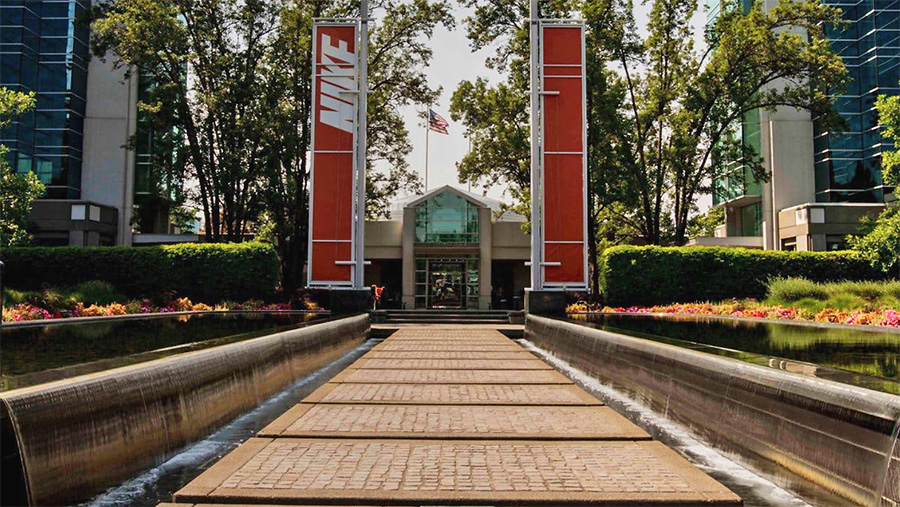
Image courtesy Nike, Inc.


